DROP
TITLE: Drop
ARTISTs: Auli Uiboupin
24 August - 1 SeptemBER 2025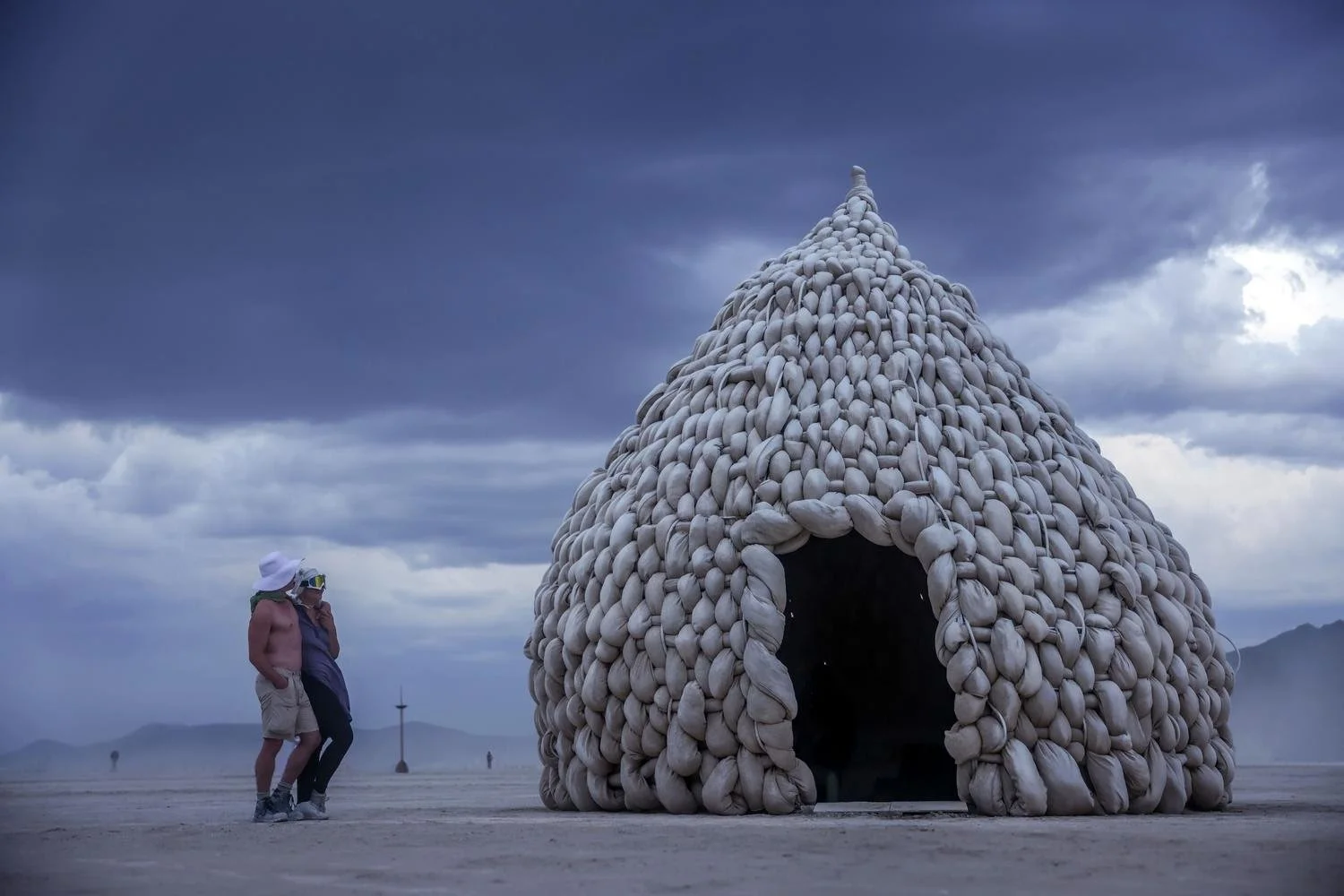
Image credit: DROP
Overview
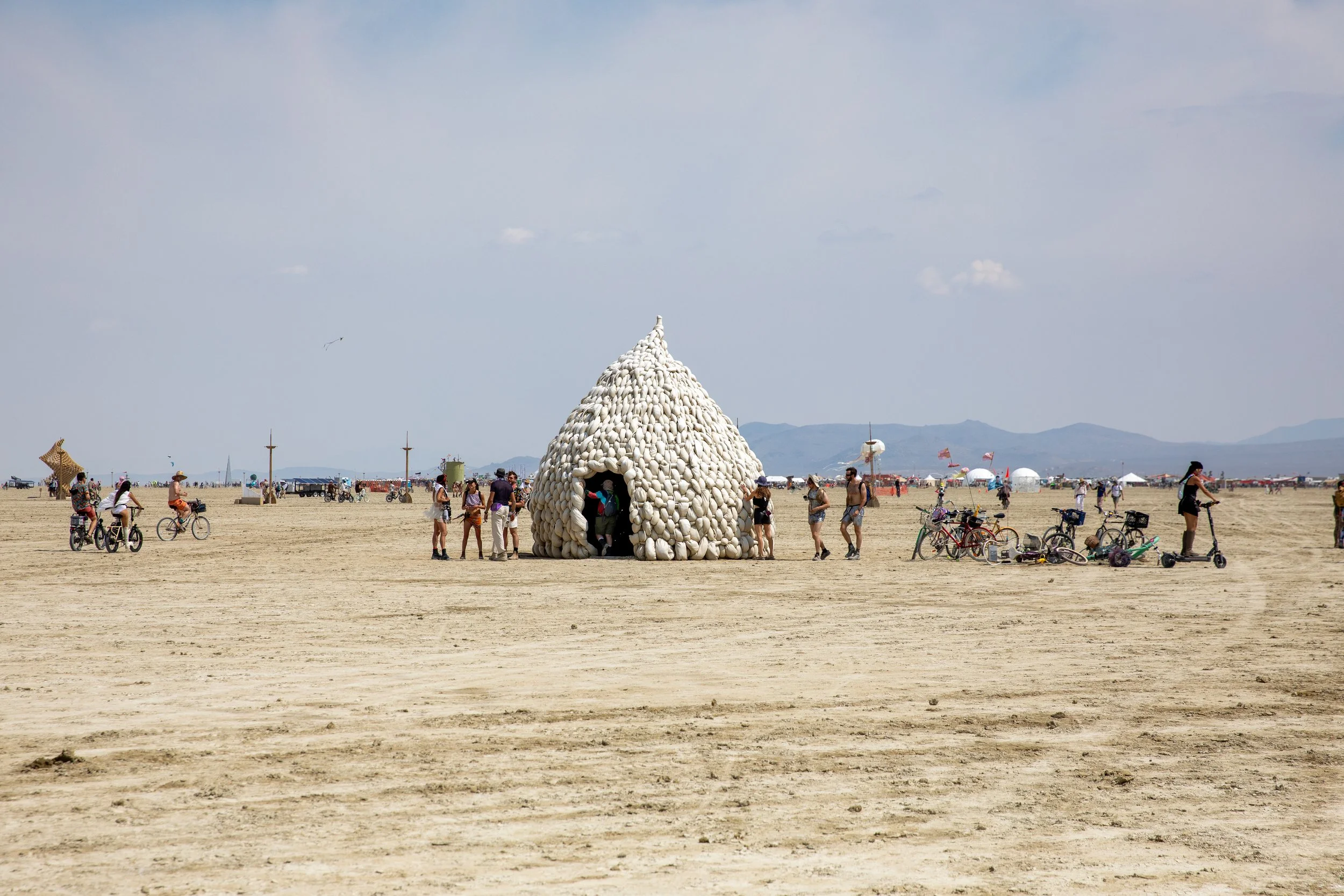
DROP is an imposing yet intimate soft sculpture representing an oversized drop of mother’s breastmilk. Crafted from a metal frame and woven entirely with textile waste, this work is designed to evoke a sense of purity tainted by environmental realities. At approximately 5.2 meters high with a 5-meter-wide base, the drop’s form dominates the space, calling attention to a deeply personal and universally maternal symbol: milk.
Context and Inspiration:
A follow-up to Microplastic Milk Rivers (2024), DROP explores themes of purity, nourishment, and contamination. In Microplastic Milk Rivers, audiences learned that microplastics were found in human breastmilk in 2022—a disturbing discovery questioning the legacy we leave for future generations. Having traveled through Estonia and eventually being exhibited at the UN headquarters in New York in 2025, this prior work established a strong foundation for DROP, deepening the conversation on pollution and birthrights.
Concept and Materiality:
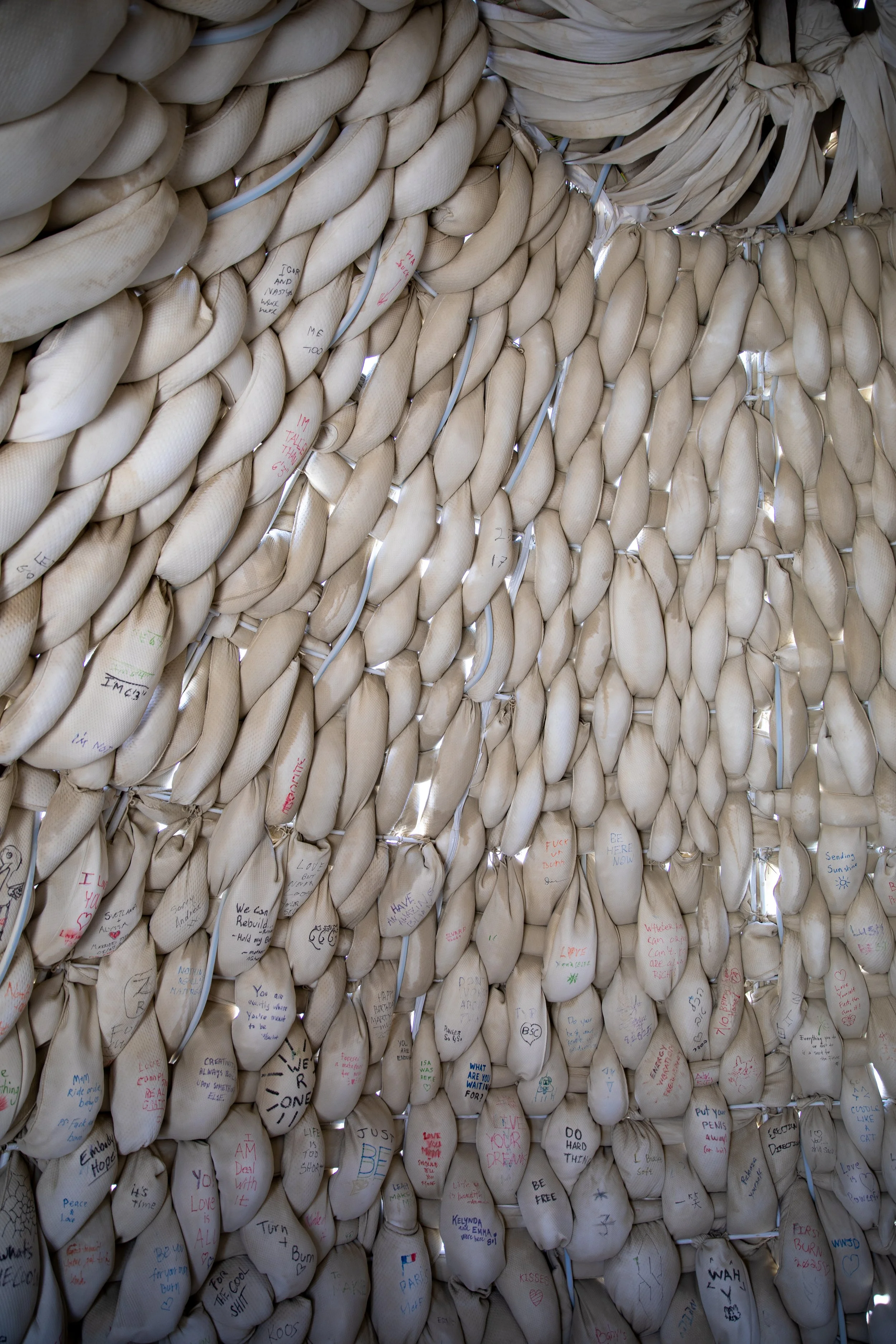
DROP is constructed as a seamless soft sculpture, woven entirely from discarded textiles—symbolic of waste and excess. The fabric creates a fluffy but smooth, milk-like surface on both the exterior and interior, providing a tactile invitation for touch and interaction. A concealed entrance door allows visitors to step inside, where they encounter a mirrored interior weave, creating a womb-like, enveloping experience. The inside of DROP serves as a small workshop space, encouraging individuals to share knowledge, skills, or stories—a place to nurture, much like the milk drop itself. Also Inside the DROP is exhibited Microplastic Milk Rivers as a reference to the Rumi quote “You are not a drop in the ocean, but an ocean in the drop”
When weaving with big soft filled fabric “worms”, it leaves plenty of spaces between them for light to enter. Textile (filled with waste batting or wadding) also works as an insulation and protection from the sand and heat during the day.
Placement and Interaction:
The sculpture sits strikingly against a desert backdrop, highlighting the idea of purity marred by exposure. The white "milk" invites viewers to touch and leave their own marks using textile paints (inside), reflecting on how even our most sacred symbols bear the imprints of human influence. The installation suggests a shared responsibility in asking: How do I want to leave my mark? It is a space for reflection, action, and creation, questioning the kind of legacy we hope to pass on.
DROP challenges viewers to confront the fragility of birthright and the impact of human presence. By leaving a visible trace, participants make a choice, contemplating the purity of beginnings and the inevitable marks we leave on our world.
Lighting:
Lighting becomes not just an artistic statement, but an experience of interconnectedness, where light becomes life, and life becomes light it embodies "mother's milk as the origin of life," with nearly 100 meters of LED strips flowing like veins of energy and microplastic rivers inside the sculpture. These illuminated pathways pulse rhythmically, symbolizing the duality of nourishment and contamination—life’s essence intertwined with environmental impact. The interplay of organic movement and artificial light creates an immersive experience, urging reflection on the delicate balance between sustenance and pollution, vitality and fragility.
Social Inclusion:
DROP is not only a statement on environmental purity and contamination but also a testament to social inclusion and the empowerment of marginalized voices. Each element of the textile-woven structure filled with batting is sewn by individuals with special needs from across Estonia's rural regions. This inclusive approach creates a tangible connection between the art and the people who have woven their personal stories, hopes, and labor into the installation.
In Estonia, people with severe disabilities receive modest social benefits, averaging around 180 EUR per month. This project provides an important supplementary income, helping alleviate financial burdens while honoring their skills and contributions. Through the act of crafting, participants are given both a creative outlet and a chance to feel their work acknowledged within a high-profile international art piece. Their work forms the very fabric of DROP, making it an expression of community resilience and collaborative art.
DROP becomes not only a conversation about pollution but also a celebration of inclusivity and interdependence. The sculpture serves as a physical testament to the idea that the well-being of our communities and the health of our planet are inseparable. By engaging people from all walks of life, DROP encourages viewers to consider the marks we leave—not only on our environment but on each other.
Sustainability:
DROP is designed with sustainability as a core principle, utilizing post-production waste materials to minimize its environmental impact. The textile shells forming the body of the drop are created from high-quality discarded fabrics sourced from production waste, repurposing materials that would otherwise contribute to landfill waste. Each textile "worm" is filled exclusively with either waste batting (wadding) or 100% shredded monofibers, both post-production by-products. This approach ensures no material mixing, making the sculpture straightforward to recycle or reuse based on the type of material.
The commitment to using pure, unmixed waste materials serves not only to highlight environmental issues but also to provide a tangible solution to waste. The materials chosen for DROP allow for an eventual second life; when the sculpture is ready to be dismantled, its components can be processed separately, with minimal impact on recycling facilities. This makes DROP a sustainable art piece that embodies the possibility of responsible consumption and production.
Moreover, the durability and insulating properties of these materials make DROP well-suited for harsh desert conditions, reducing the need for frequent repairs and lowering resource consumption over the sculpture's lifespan.
The DROP installation exemplifies how art can bridge environmental consciousness with practical, low-impact solutions, offering an example of sustainability in public art while promoting broader conversations about waste and responsibility.
DROP draws a direct link between the well-being of communities and the health of the planet. By showcasing the stories and labor of its makers, it underscores the idea that sustainability is not just an environmental issue but a social one. It highlights how systemic problems like pollution and inequality are intertwined, requiring holistic solutions.
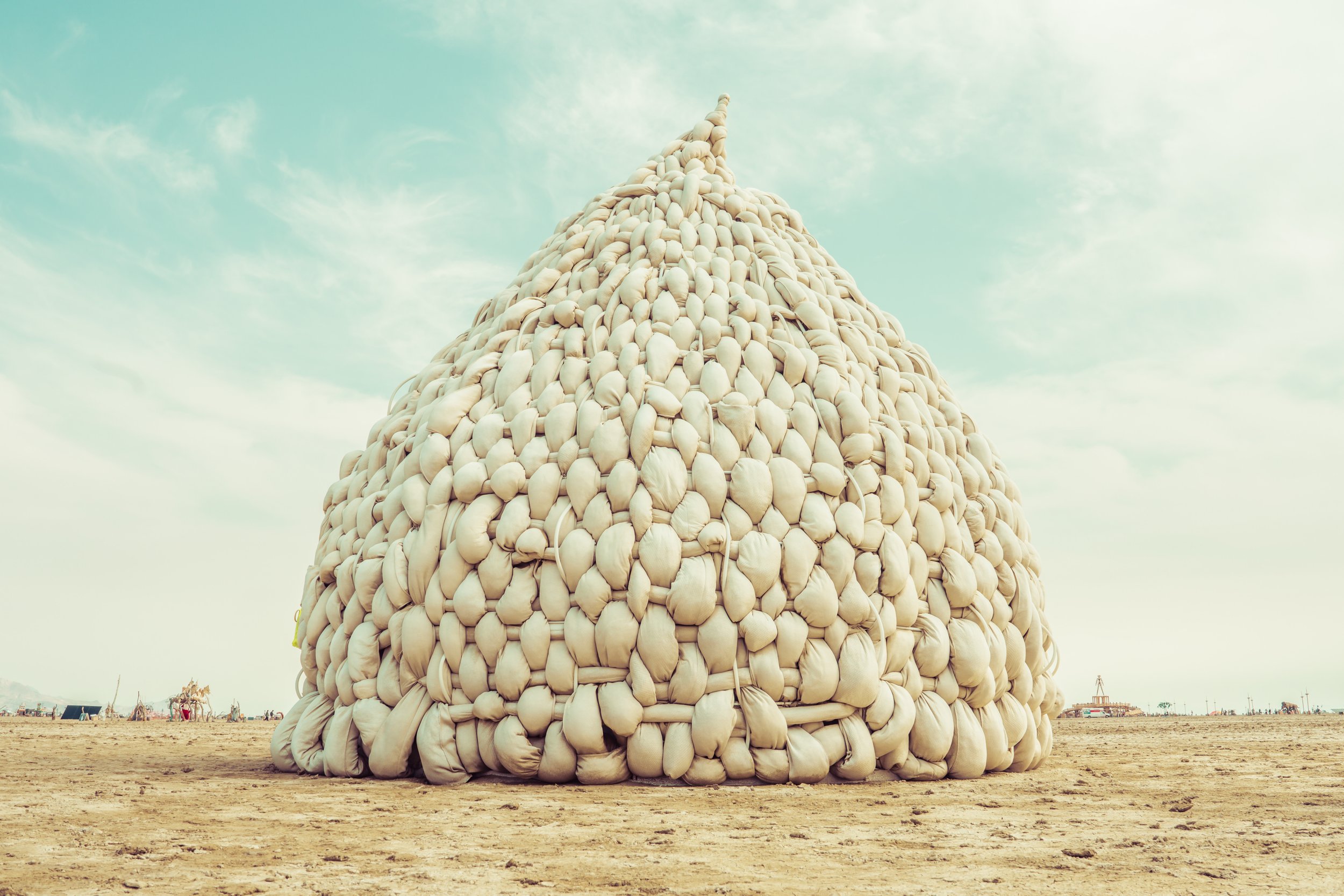
DROP_After the storms
Climate Approach to Project
DROP project is grounded in a clear climate-conscious philosophy that aligns artistic creation with environmental responsibility. It embodies the principles of circular design, material reuse, and community-based sustainability.
At its core, DROP reduces environmental impact by using 100% reclaimed textiles and salvaged metal from local sources. These materials are diverted from the waste stream and reimagined as part of a large-scale installation, demonstrating how creativity can extend the life of discarded matter.
The project’s production process follows a low-carbon approach:
Material sourcing: All fabrics are collected through the Tekstiilitakso and Tekstiilitalu circular textile systems, preventing textile waste from entering landfills.
Local fabrication: Construction and assembly occur within local workshops and community spaces, minimizing transportation emissions.
Renewable energy and manual processes: Whenever possible, manual techniques (stitching, stuffing, joining) replace energy-intensive machinery, reducing energy use.
Lifecycle thinking: After exhibitions, the installation’s textile components can be disassembled and reused in future artworks, workshops, or educational projects.
DROP is both a symbol and a practice of regeneration, illustrating how climate action and creative expression can coexist. It encourages viewers to rethink their relationship with material consumption and to imagine a world where beauty and sustainability are inseparable.
Carbon Emissions from Travel (tCO2e): 5.31 tCO2e
Carbon Emissions from Shipping (tCO2e): 0.24tCO2e
Carbon Emissions from Energy Use (tCO2e): 0.06 tCO2e
Emissions - Other Categories (tCO2e): 0.02
Emissions - Accuracy: Somewhat Accurate
Emissions Calculation Description & Methodology:
System boundary:
Calculations include all major project-related operational emissions — travel, freight, and on-site energy. Audience travel and general infrastructure impacts (e.g., airport or port operations) are excluded.
Activity data (actual & projected):
Travel: Two team members flew round-trip from Tallinn (Estonia)to San Francisco (USA) in economy class for installation and deinstallation.
Shipping: 1.3 tonnes of sculpture materials transported by sea freight (Tallinn → Hamburg → Norfolk, VA) and by rail freight (Norfolk → Oakland, CA).
Energy: The installation site in Black Rock City (Playa) was fully powered by off-grid solar batteries, resulting in zero emissions from energy use.
Materials & Printing: The installation was built from 100% reclaimed textiles and salvaged metal, collected through Tekstiilitakso and Tekstiilitalu systems. No new textiles, packaging, or print materials were produced. This diverts waste and avoids embodied emissions typically associated with virgin material manufacturing and printing.
Emission factors:
Flights: 0.146 kg CO₂e / passenger-km
Sea freight: 0.015 kg CO₂e / tonne-km
Train freight: 0.022 kg CO₂e / tonne-km
Energy: 0 kg CO₂e / kWh (solar)
Material offset: Estimated –0.3 to –0.5 tCO₂e avoided through textile and metal reuse
Method:
Each emission source = activity data × emission factor, converted to tonnes of CO₂e (tCO₂e). Material reuse impacts were conservatively treated as avoided emissions, representing the carbon that would have been released if equivalent new materials were produced.
Results:
Travel: 5.31 tCO₂e
Shipping: 0.24 tCO₂e
Energy Use: 0.00 tCO₂e
Material Offsets: ≈ –0.4 tCO₂e
Net Total: ≈ 5.15 tCO₂e
Waste Report Description & Methodology:
1. Description & Intent
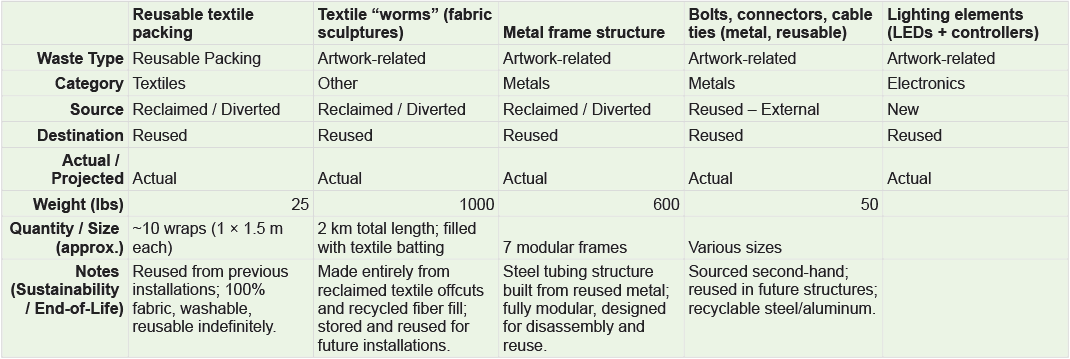
This report outlines all significant material uses, waste streams, and circular strategies applied in the production of the DROP installation. The focus is on transparency of material origins and destinations, aiming to minimize landfill contribution and prioritize reclaimed or reused materials.
A full inventory of items purchased or sourced under the project budget is included. All weights are actual where possible and based on recorded measurements during fabrication and assembly.
2. Methodology
Inventory Tracking: Each major material input was logged with its source, weight, and intended end-of-life pathway.
Classification: Materials were categorized by waste type and source key:
New: Purchased new
Reused (Internal): Repurposed from existing studio stock
Reused (External): Borrowed or purchased used
Reclaimed/Diverted: Rescued from landfill or post-consumer textile streams
Destination Recording: Post-use or long-term plans were noted (reused, stored, recycled, composted, etc.).
Scope: Report includes only items that are required to be documented — Reusable Packing and Artwork/Fabricationmaterials.
3. Material Inventory Summary
4. Summary of Circular Performance

5. Sustainability Notes
All textile materials were sourced through Tekstiilitakso and Tekstiilitalu circular textile systems, diverting them from landfill.
Metal structures and components were modular to enable full disassembly, transportation, and reuse.
No single-use packing materials were employed; only reusable textile wraps were used for transport.
LED lighting components were chosen for low energy consumption and retained for reuse.
Project demonstrates a closed-loop material system — no landfill waste generated.
6. End-of-Life Plan
Following exhibition or event use, all components are stored under JÄÄK OÜ’s circular art and material reuse inventory, available for:
Future exhibitions or installations.
Educational reuse (e.g. sustainability workshops).
Material redistribution via the Tekstiilitakso network.
Climate Actions Tracker:
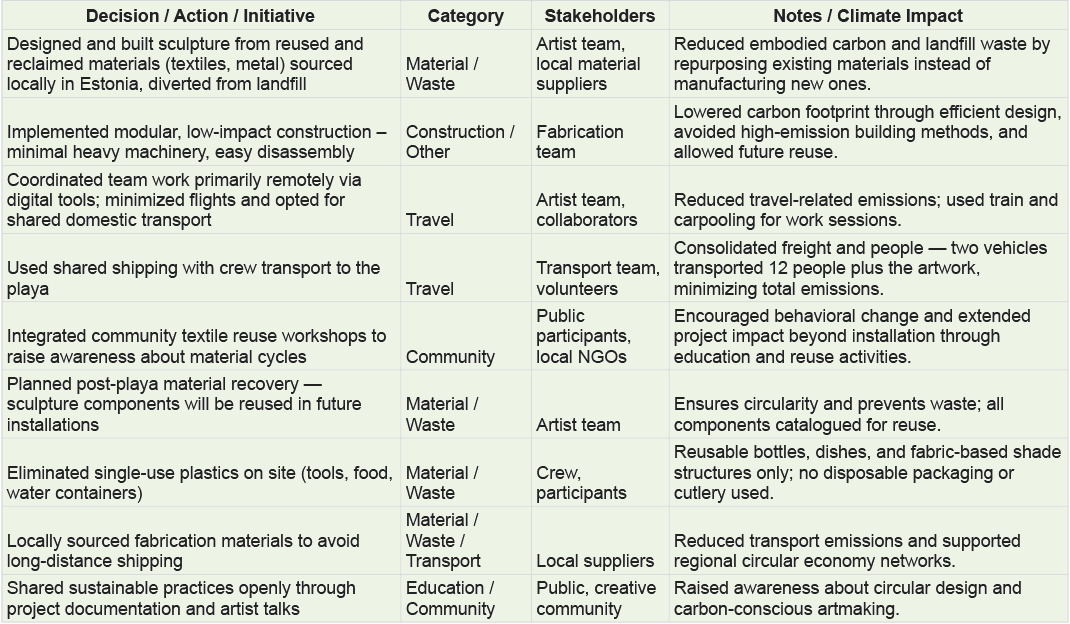
How did the project support staff to take climate action?
1. Awareness and Education
Climate-focused onboarding: All team members were briefed on the project’s circular design principles before fabrication began. The team discussed the carbon impact of materials, transport, and construction, making sustainability a shared responsibility rather than an afterthought.
Knowledge sharing: The project included short workshops and informal discussions on low-carbon art practices, waste segregation, and local recycling/reuse networks in Estonia.
Empowerment through context: Team members understood why reclaimed textiles, modular structures, and local sourcing mattered — enabling them to apply these principles in their future creative work.
2. Sustainable Work Practices
Remote collaboration: Staff were encouraged and supported to work remotely wherever possible. Digital planning tools (shared folders, online meetings) replaced unnecessary travel and reduced fuel use.
Shared local travel: When in-person work was needed (e.g. fabrication or installation), carpooling and consolidated travel days were organized to minimize transport emissions.
On-site low-impact systems: Team areas used reusable containers, fabric-based shade, and rechargeable lighting, modeling sustainable living practices in the field.
3. Inclusive Climate Culture
Collective decision-making: Environmental considerations were integrated into every creative and logistical decision — from how to ship materials to what fasteners to use.
Encouragement of individual actions: Crew members were invited to bring their own reusable bottles, tools, and materials, and to share ideas for greener solutions.
Mutual accountability: Climate impact tracking was made transparent to the whole team, so everyone could see their contribution to emissions reduction.
4. Skills Development and Legacy
Hands-on circularity training: Team members participated in textile sorting and reuse sessions, gaining first-hand experience in material recovery and transformation.
Capacity building: The project built confidence among local makers and technicians in applying modular, low-waste fabrication methods.
Ripple effect: Several collaborators have since integrated reclaimed materials and low-carbon logistics into their independent creative practices.
5. Wellbeing and Purpose
By connecting environmental action to artistic meaning and community benefit, the project helped staff feel motivated and proud of their climate-conscious decisions.
Team culture emphasized care — for materials, people, and the environment — reinforcing the idea that sustainability is not a constraint, but a creative and ethical framework.
How did the project promote collective action or movement building?
1. Building a Network Around Material Circularity
The DROP installation was conceived not just as an artwork, but as a node in a growing movement connecting artists, waste handlers, and communities in Estonia and beyond.
Through collaboration with Tekstiilitakso and Tekstiilitalu, the project integrated art into the existing textile reuse and diversion network, demonstrating how creative practice can advance material recovery.
Partnerships with local municipalities and community organizations helped build shared infrastructure and communication around textile reuse, extending the impact beyond a single event.
This network continues to grow through open sharing of methods, inviting others to replicate circular systems in their own contexts.
2. Engaging the Public Through Participatory Creation
Members of the public and volunteers participated in textile preparation, sorting, and stitching, directly experiencing the transformation of waste into art.
These workshops acted as collective climate actions, making visible the connection between individual choices (donating or mending textiles) and systemic change (reducing waste streams).
The process emphasized care, repair, and co-creation — turning climate concern into tangible, shared activity.
3. Demonstrating Scalable Circular Systems
DROP served as a proof-of-concept for circular design principles that can be scaled to other art, education, or municipal reuse projects.
By documenting all materials, sourcing paths, and reuse outcomes, the project created a transparent model others can follow.
The installation was presented as part of a broader dialogue on regenerative culture, bridging art, sustainability, and social enterprise.
4. Inspiring Climate Dialogue and Collective Imagination
The artwork’s immersive, sensory experience fostered emotional engagement helping audiences feel the interconnection between matter, ecology, and human systems.
Public talks and documentation shared during the project invited reflection on the relationship between consumption, waste, and renewal, sparking conversations that reached artists, educators, and policymakers (in Estonia).
Reflections from Presenting Partner, Artists, and other stakeholders:
The process deepened the team’s understanding of circularity as an artistic method, not just an environmental principle.
Building a modular, transportable structure out of reclaimed materials reinforced that beauty and responsibility are not opposites, but interdependent.
The collaborative process emphasized trust, adaptability, and care — for each other, for materials, and for the ecosystems we inhabit.
Volunteers expressed a sense of agency and ownership in climate action, seeing direct impact through their hands-on involvement.
The workshops blended skill-sharing with reflection, helping participants understand how creativity intersects with sustainability.
For many, the project reframed waste not as a problem, but as an invitation to create differently.
Exhibition credits:
My biggest gratitude and brightest blessings to Lotus Art Fund. This would have NOT been possible without them. I would also like to thank the Burning Man Project.
And: Rando Hein, Elis Uiboupin, Taavi Vendt, Kadi Liivik, Agris Stüf, Lisett Liiv, Henri Pikla, Silver Sõber, Annika Remmer, and Kaur Türk.