Laboratory for The Future | Propeller Gallery at Santa Monica Airport
Climate Impact Report
Debra scacco ‘laboratory for the future'
PROpeller gallery at santa monica airport
11 October 2025 - 5 January 2026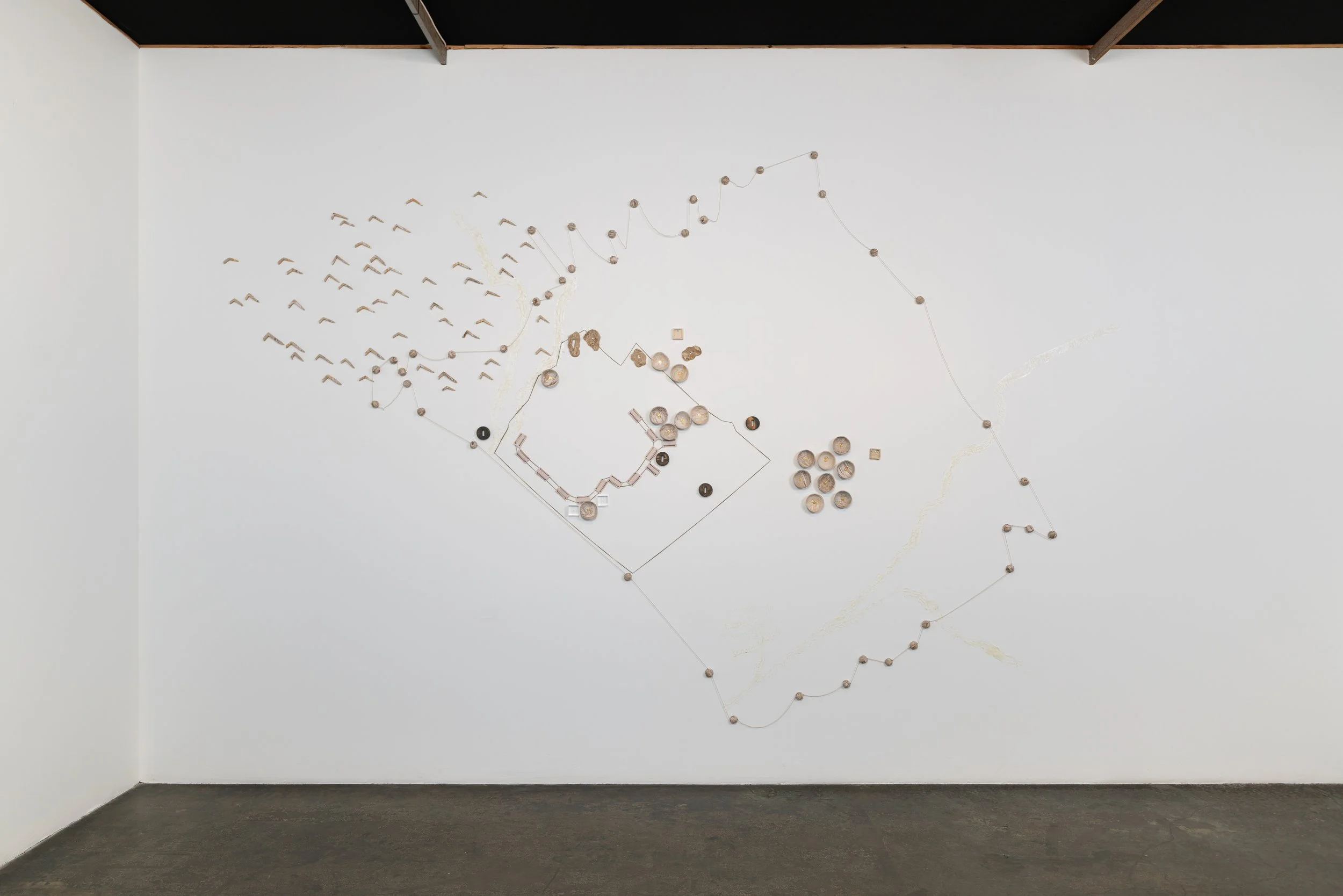
Introduction
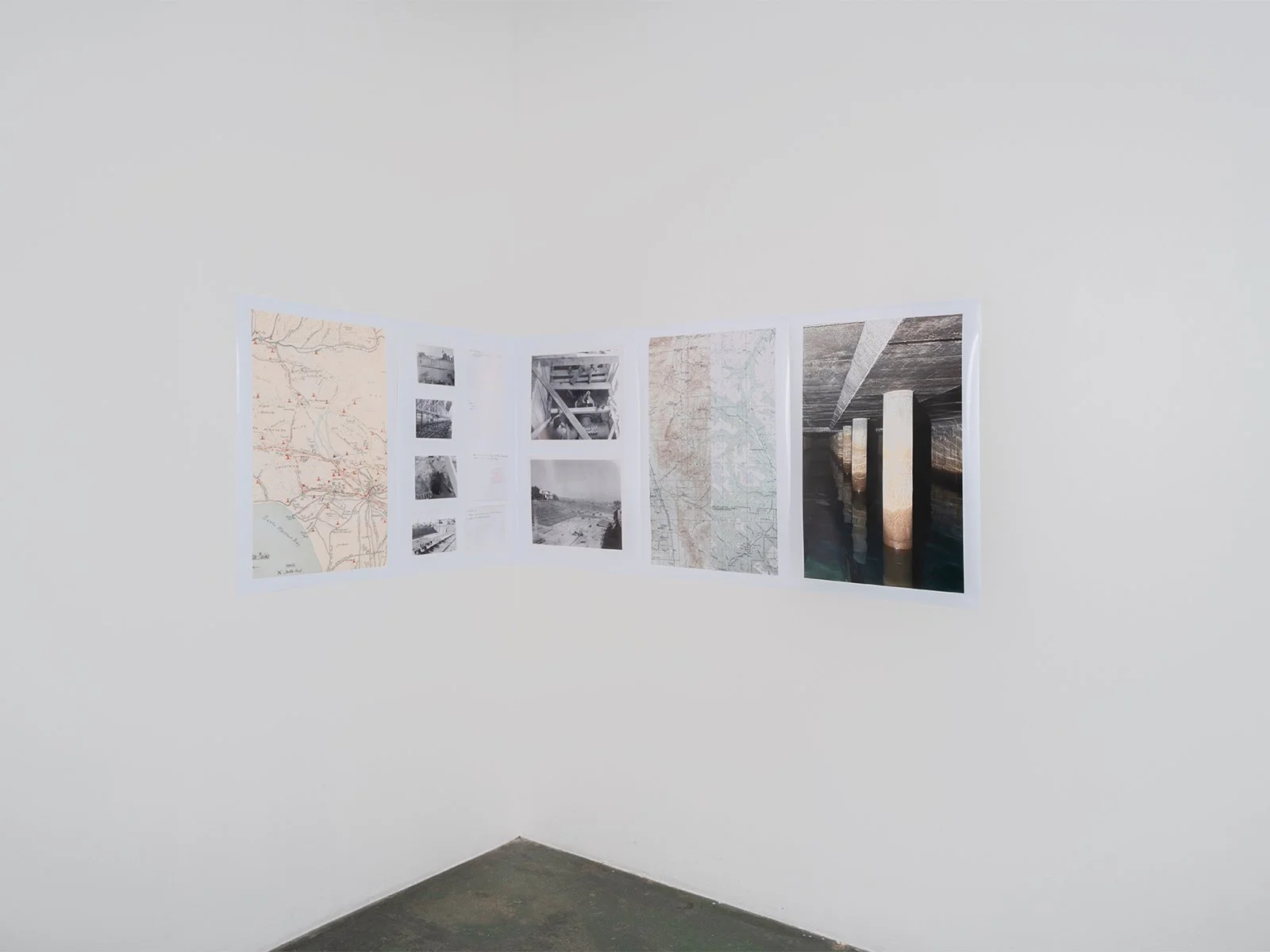
This exhibition marks the conclusion of my two-year tenure as the inaugural artist-in-residence at the City of Santa Monica’s City Yards. While I engaged with many across Public Works, my work centered on the Water and Resource Recovery & Recycling Divisions. Research took the form of shadowing sanitation and water workers; visiting well sites, reservoirs and transfer stations; connecting with local Indigenous water stewards; and, most importantly, building community around this research and its outcomes. The material foundations of this exhibition grew directly from this fieldwork and relationship building, which allowed me access to spaces and knowledge that changed my way of thinking.
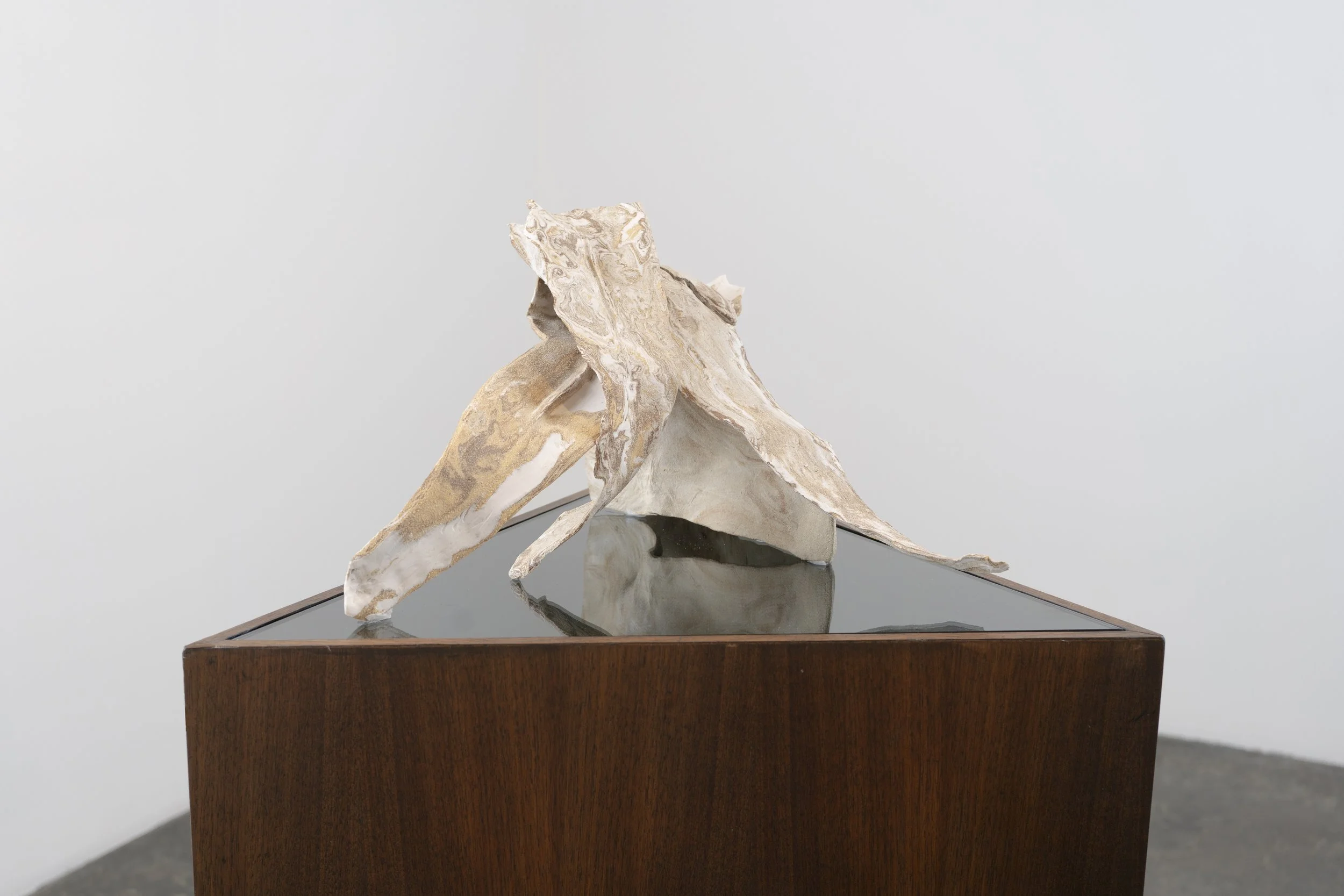
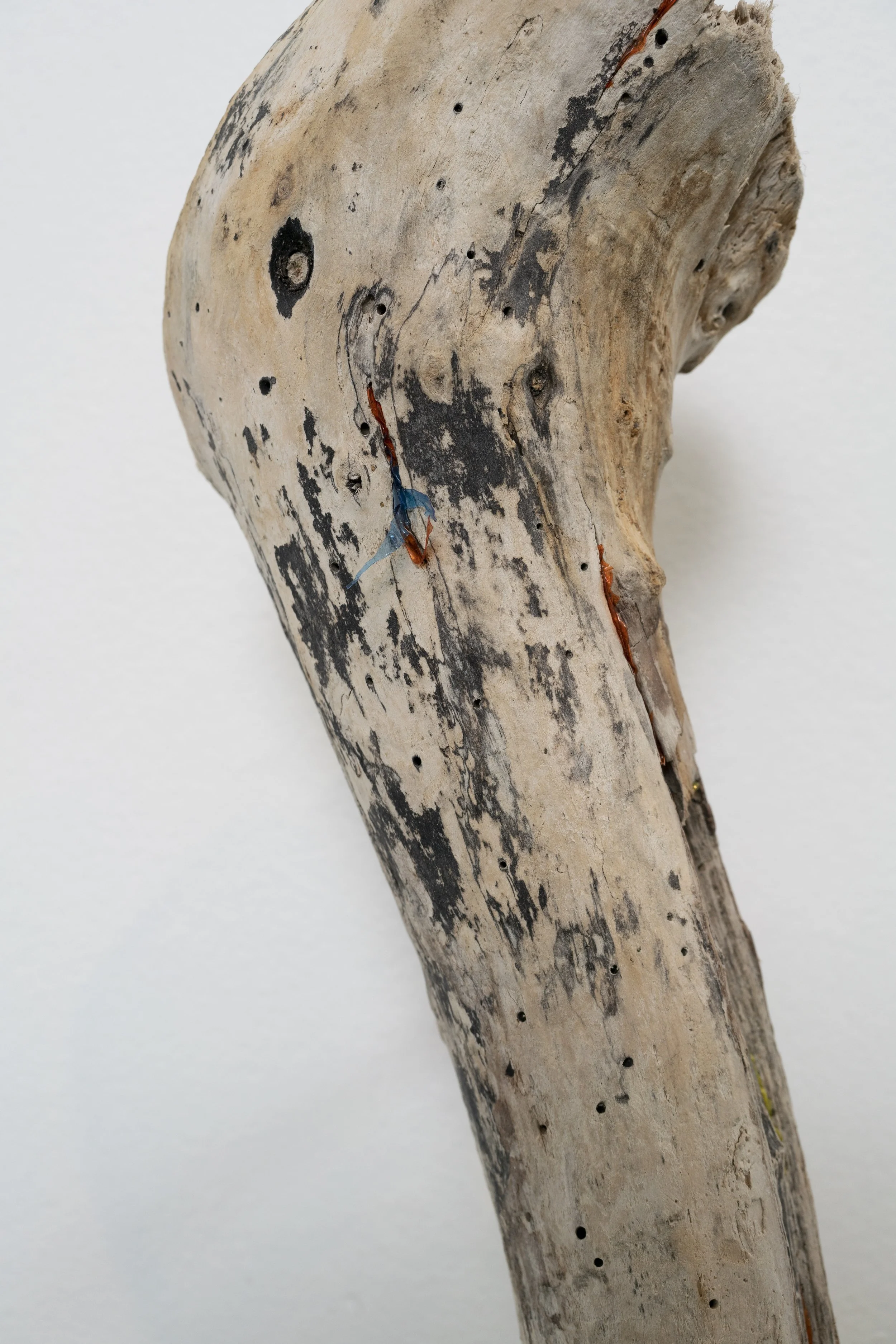
I will be absorbing what I learned here for years. The complexity of the networks that hold a city together is vast, and the experience left me with an urgent call to re-earth. It is for this reason that the key material in the exhibition is clay extracted from a local well site, and driftwood washed up on Santa Monica beach. This project, and more broadly my practice, aims to make the invisible visible: not only the infrastructure that sustains daily life, but the people who maintain it and the natural systems that make it possible. It also serves as a reminder that people invented these complex systems; and that the invention is not done. In the face of our climate emergency, reinvention is key.
The Climate Impact Report serves as both record and reflection: an opportunity to consider how decisions emerge within municipal systems, and how creative practice can reveal new ways of seeing. As the first to hold this role, I have also been asked to imagine what might support future artists. This document offers learnings for both forthcoming residents and the wider creative community.
What this report does not include is the extensive social-practice dimension of the project: the shared meals, the festival that featured a local youth orchestra and compost give-aways, the banners and sanitation truck posters honoring essential workers, the events pairing Indigenous and infrastructural water practice and conversations about the joys and complexities of being a woman in Public Works. While this report focuses solely on the exhibition, this layered social practice work will be explored in depth in a forthcoming publication (Spring 2026), which will also reflect on the climate impact of social practice work.
Existing Climate Policy
For more than two decades, my practice has lived at the intersection of ecology, public policy, and human movement. My work traces the complex chains of cause and effect set into motion when humans intervene in natural systems. These interconnected dynamics shape not only landscapes, but also the lived experiences of the human and more-than-human communities who depend on them.
As an artist working in the midst of a climate emergency, I am often in tension with the act of producing material objects. Therefore each material and its lifecycle is considered - including where and how clay is sourced, wood and glass for frames, paints, solvents, adhesives, etc.
This contradiction guides my commitment to a circular studio methodology: reuse, recirculate, purchase virgin material only when necessary, and recycle and send to landfill only as a last resort. Materials move through the studio in cycles, gaining new lives whenever possible rather than contributing to waste streams.
Each exhibition is paired with offsite public engagements — at a river, in a garden, beside a reservoir — designed to relocate climate concern from the theoretical to the lived. These gatherings ask us to experience environmental change with our community and in our bodies as well as our intellect, grounding conversation in place, context, and collective presence.
This work is made possible by people, and supporting people is key to a successful studio. In any system, scarcity reinforces the status quo, limiting the capacity for change; we therefore work intentionally against it. All staff and collaborators are paid above a living wage, and health and safety are built into every decision. We take breaks, maintain reasonable hours, eat well, and check in with one another. These are not peripheral concerns—they are essential conditions for producing climate-focused work with integrity.
I extend this systems-based approach to every collaborator, institution, and host venue I work with. Each partnership is an opportunity to examine how material, logistical, and interpersonal choices tangibly shape outcomes. This shared framework guides my studio and the broader ecosystem of each project.
Across all projects, I aim to share information without judgment. My intention is not to moralize, but to witness: This is where we are. This is where we are headed. From that acknowledgement, I invite the question, What is the future we can dream and build together?
Emissions
I attempted to calculate the seemingly core emissions: my car travel over a period of two years and a 75 person catered lunch for the exhibition opening. I tried to calculate the specifics of the meal but it became overwhelming to arrive at a number as it was difficult to find a carbon calculator for ingredients, I received conflicting information from various sources and I don’t have access to the full ingredient list.
Travel
.44 tCO2e
Shipping
No shipments
Building Energy
I did not have access to building energy. However, there are tenants in the gallery even when an exhibition is not open; therefore the exhibition did not add to the carbon footprint of the building.
Other
I catered a thank you meal for Public Works employees. I know from past events that meat is highly preferred to vegetarian or vegan food. I wanted to honor this while also serving vegetarians and vegans, and hoping to encourage meat eaters to try something new. The meat options disappeared within minutes and visitors were pleasantly surprised by the options that they considered their second choice. I was unable to calculate reliable emissions on the food as I received conflicting source information.
Total Calculated Emissions .44 tCO2e
Materials & Waste
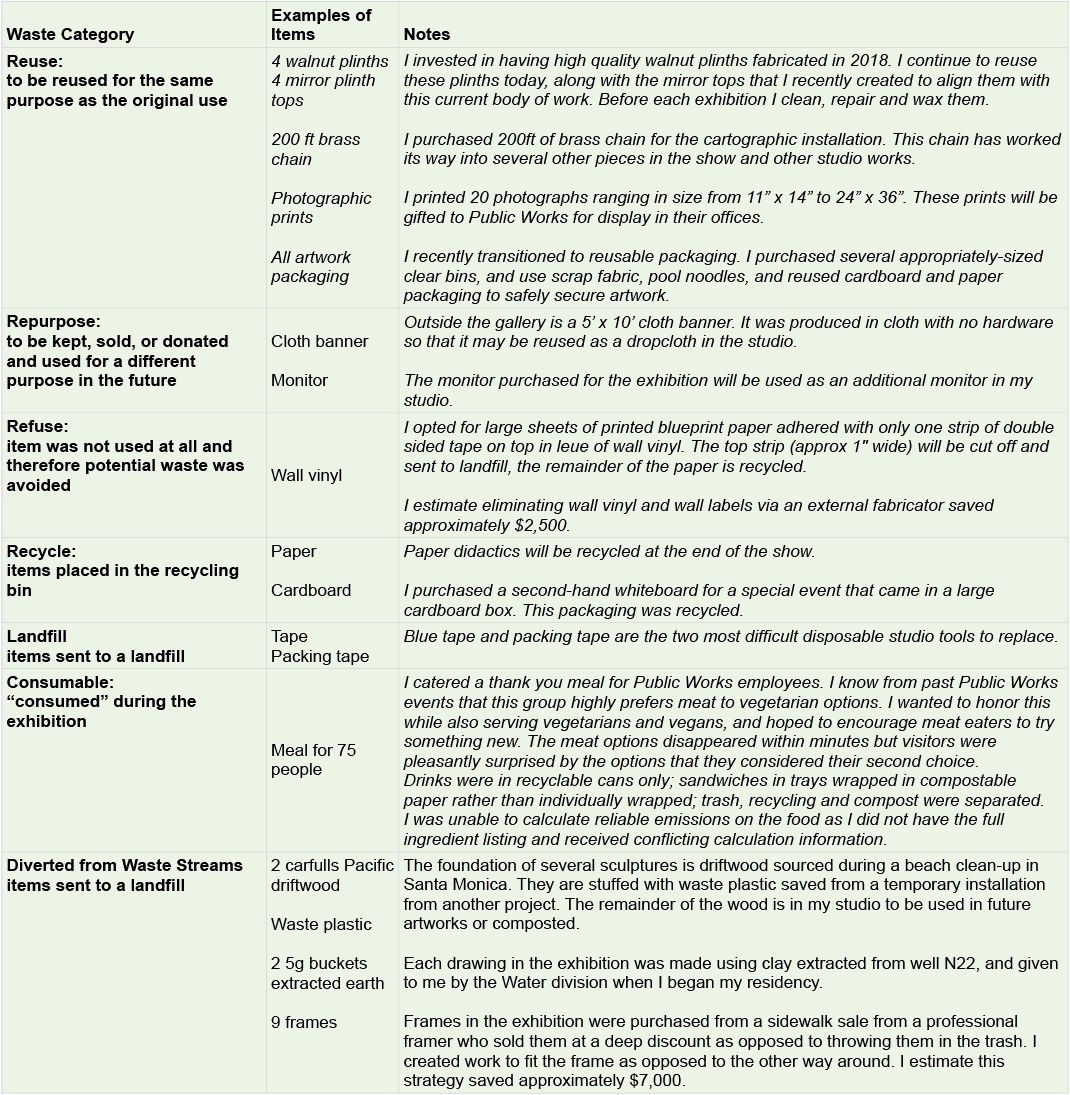
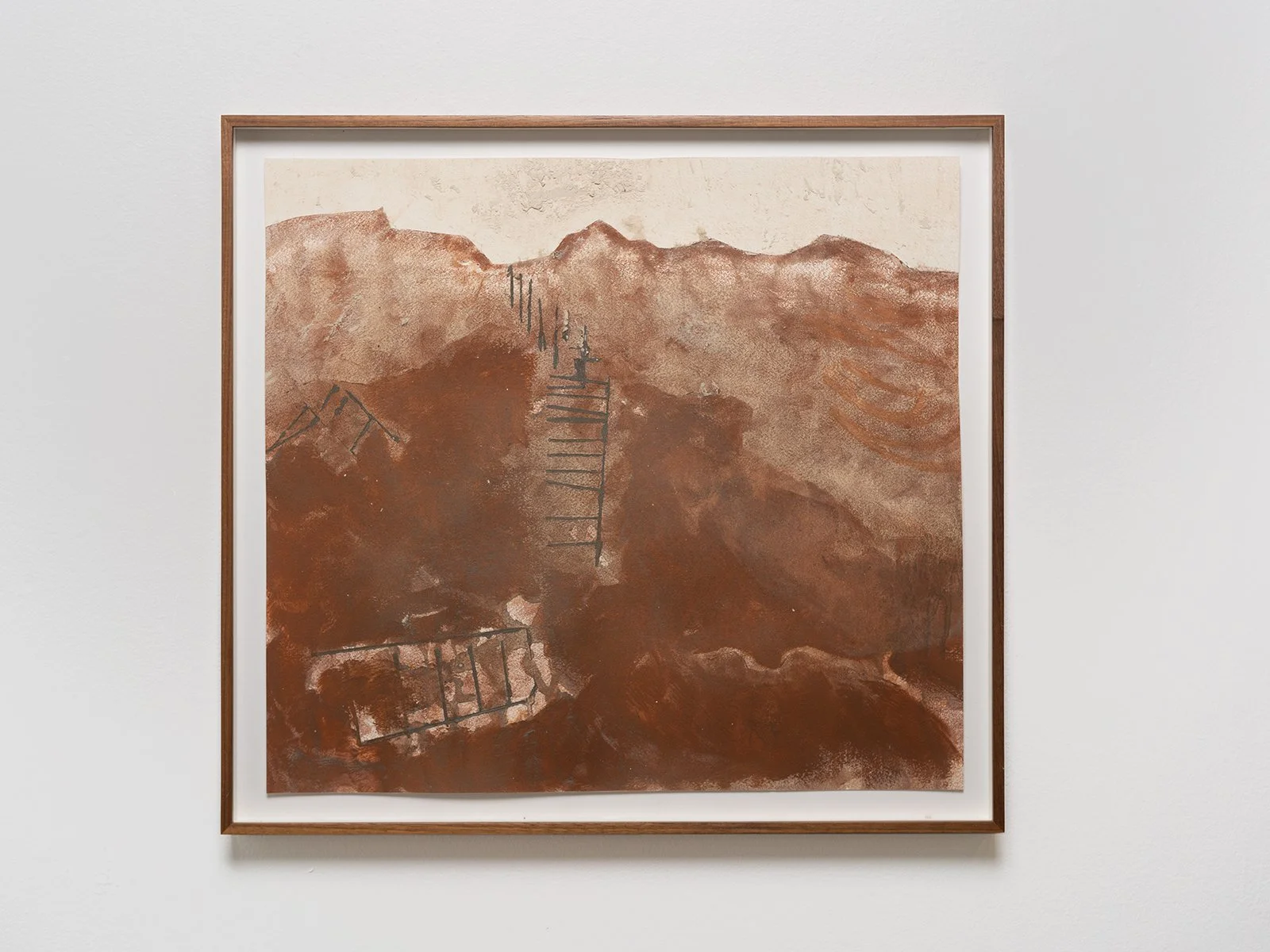
Supporting People
Supporting people is one of the most overlooked yet essential forms of climate action. Care, connection, and dignity create the conditions that make climate engagement possible, placing the right to a stable and dignified life at the center of all climate work. Climate action is cultural, with supporting the whole person as its foundation. When people are supported, connected, and inspired, they are far better equipped to vision and co-create a resilient future.
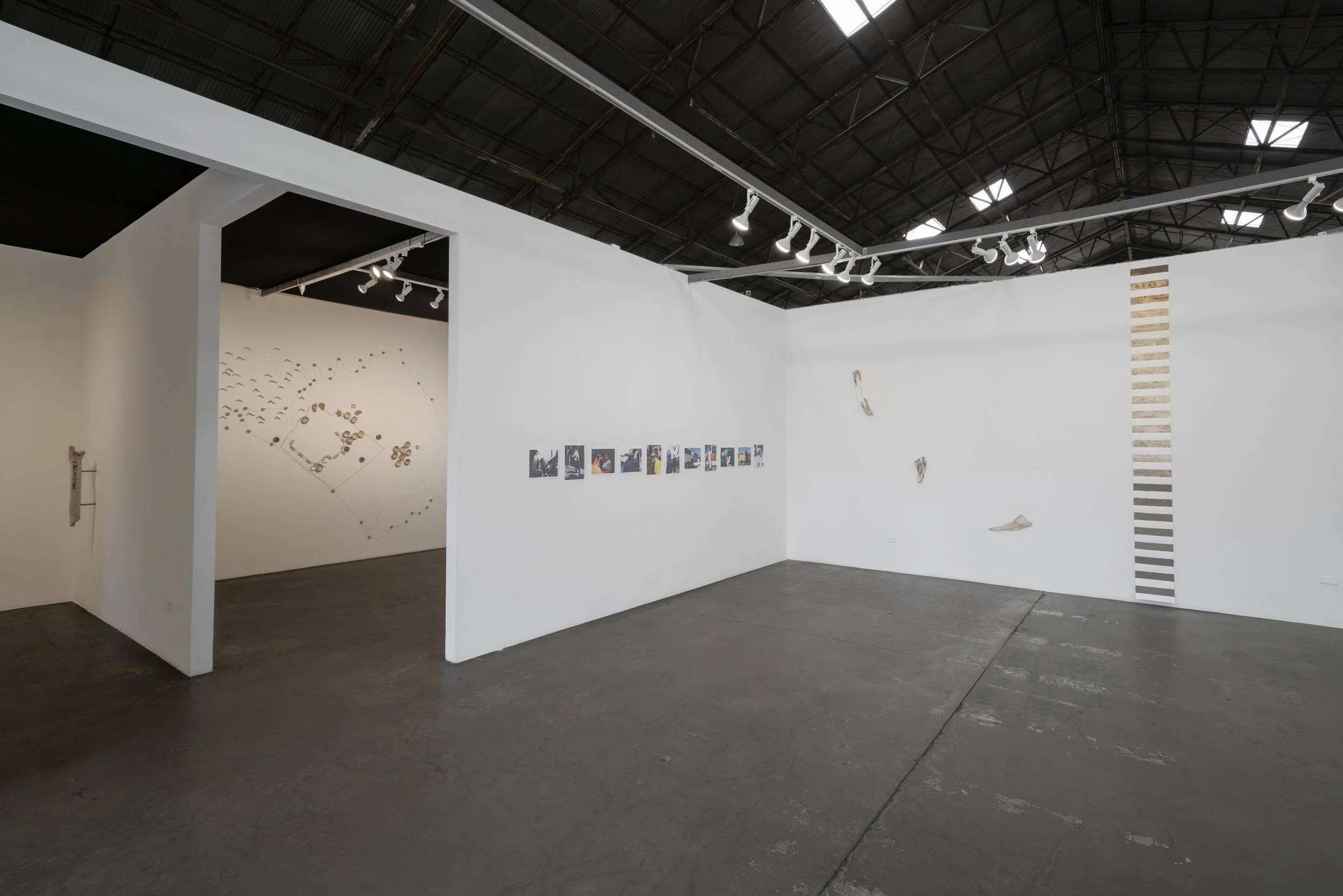
In my practice, supporting people begins with listening. Working alongside city staff in water, sanitation, and public works, I witnessed how much climate-related labor happens quietly and without recognition. Celebrating these individuals through portraits in the main gallery alongside a VIP opening meal exclusively for public works staff was at the heart of this exhibition, as this work would not be possible without these extraordinary individuals.
Support also extends to the team behind the work: studio assistants, fabricators, installers, etc. Everyone is paid a living wage, with clearly stated expectations, regular check-ins and time for breaks. We collaborate on material circularity strategies, openly sharing ideas that result in consistently impactful results. I publicly credit, with permission, the full team whose labor shapes each project.
Each exhibition is also an opportunity to support those advancing climate justice beyond the studio. Programming for this exhibition included Diné Navajo artist and water protector Emma Robbins on Indigenous water justice; author Arianne Edmonds on the history of Black Los Angeles post-Reconstruction; an anti-censorship action as part of Fall of Freedom with artist and organizer Kim Schoenstadt; a hands-on composting workshop with Teague Weybright; and a conversation on scaling individual action into institutional impact with climate-focused art workers Deville Cohen and Laura Lupton. Each of these free programs were designed to share practical strategies and strengthen community capacity.
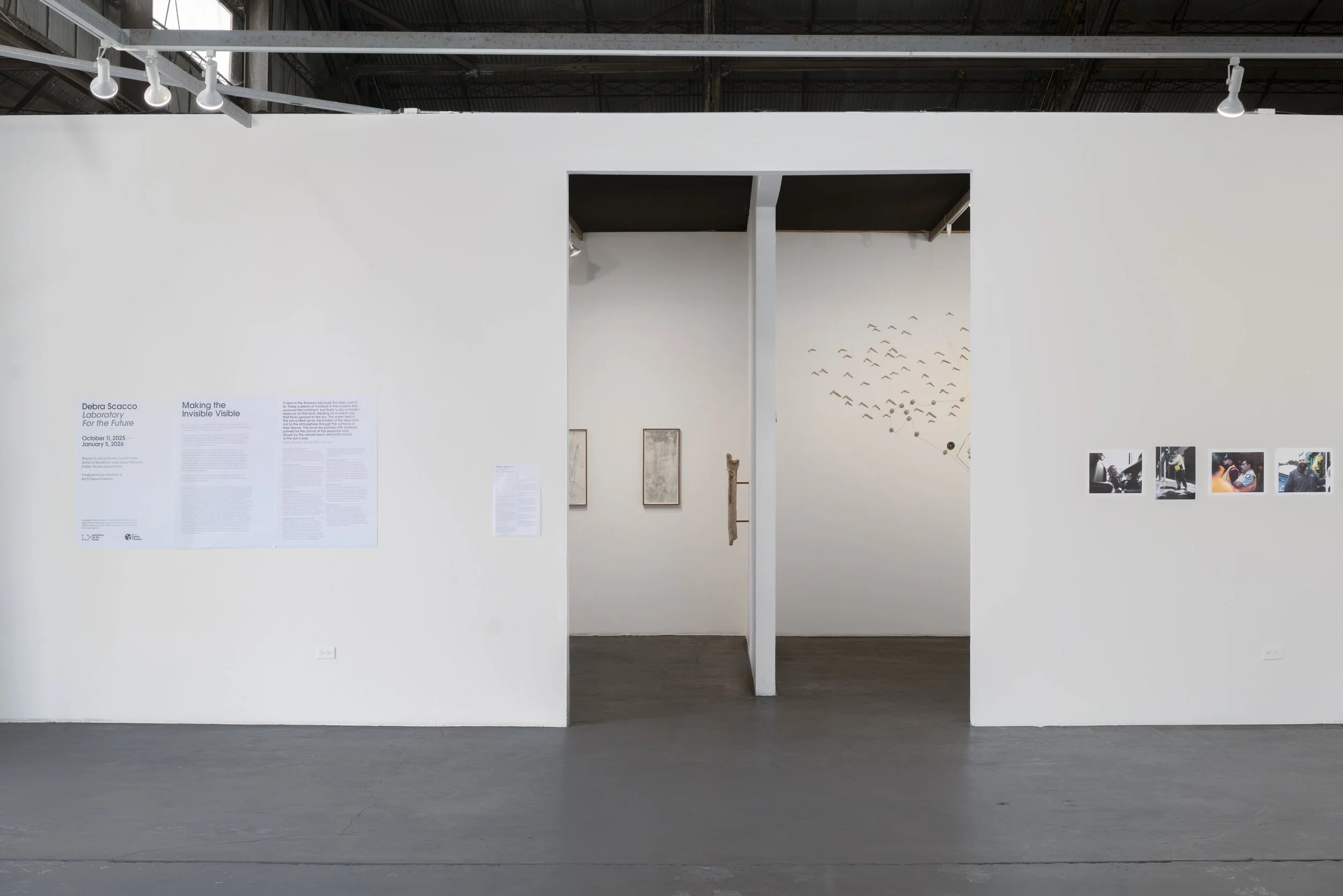
Project Specific Sustainability Concerns
Pain points I continue to encounter:
Wall vinyl
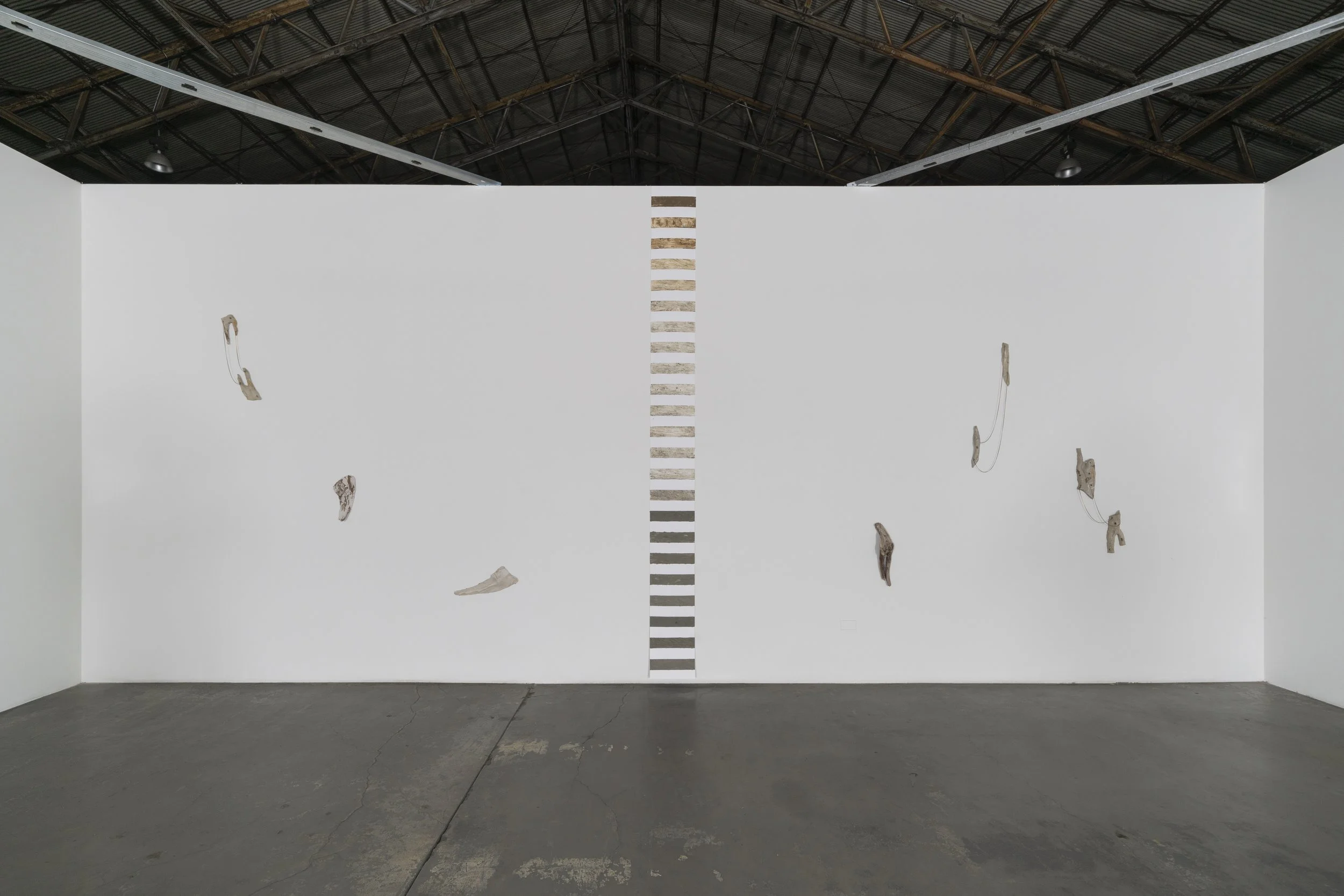
While I was happy with the stylized solution to wall vinyl in this exhibition, blueprint paper is delicate and requires more attention and maintenance once on the wall. The extremely low price point (approx $4 per 36” x 48” blueprint) makes this feasible. I will continue to test for a more durable climate-friendly solution for future projects.
Tape
Tape is one material that I simply don’t know how to replace, and the material I most often send to landfill. As a lot of my work is installation based, I heavily rely on blue tape to mark out areas and installation components. I will continue to search for an alternative.
Catering
When trying to cater zero waste events (especially when I am the host and only staff member present), I experience conflicts between the sanitary nature and ease of individually packaged foods and the waste this packaging presents. I attempted a hybrid for this event with trays of sandwiches wrapped in compostable paper and bamboo plates and cutlery. However, the individual snacks (crisps, protein bars, individual servings of nuts, etc) all come wrapped in plastic film. I also learned the space does not have a compost facility, so I brought this home to put in my own green bin. I also initiated a conversation between the space and the city to facilitate composting here in the future.
Disposable gloves
Vinyl gloves continue to be a pain point with no clear replacement.
Closing Thoughts:
As an artist, curator, organizer, educator and generally climate-aware person, I encourage every culture worker to produce at least one Climate Impact Report. The format creates a thoughtful, non-judgmental space for reflection. It provides an opportunity to record what’s exciting, what’s working, what’s difficult and, over time, how far we’ve come.
When I look back at the first CIR I created in 2022 for Song of the Cicada at Honor Fraser Gallery, I remember being terrified and overwhelmed. I thought producing a CIR would intensify my long-standing guilt of making more objects in the midst of a climate emergency. I often wondered if any of this mattered. What I’ve learned from my listening and learning between then and now is that this work — art work, climate work, culture work — matters not only to me, but to so many. It nurtures us in a way that nothing else can. I also learned that when we share our concerns, our attempts, our progress, and yes our failures, the work moves faster and feels lighter.
Just three years later, my practice has shifted in ways I could not have imagined. This is thanks in no small part to the generous, inspiring artist-volunteers at Artists Commit and to the openness and flexibility of the CIR format itself. Climate accountability is now woven into my day-to-day practice. I frequently swap strategies with friends and colleagues, speak about this work in classrooms and on panels, and had the privilege of co-leading the Getty PST ART Climate Impact Program with my friend, collaborator, and Artists Commit co-founder Laura Lupton. We will forever be excited by our colleagues’ photos of empty dumpsters.
I am deeply grateful to Artists Commit for creating and sustaining a home for this work, and to my dear friend and constant source of inspiration Jenny Kendler for bringing me into this community. It has expanded my practice, my thinking, and my sense of what is possible; and has enriched my life in ways I am still uncovering.
My hope is that this report serves as an invitation: not to perfection, but to participation. To step into this work with curiosity, courage, and care. We move further, and with far more joy, when we move together.
Credits
This exhibition is among the final chapters of my two-year tenure as artist-in-residence at City of Santa Monica City Yards (Department of Public Works: Water and Resource Recovery & Recycling Divisions). The following list of contributors is by no means exhaustive.
Studio and fabrication team Kate Burrows, Eric Blair, Michael Dodge, Emory Hall, Alina Horsley, JI, Robin Wright. Creative and festival collaborators Tanya Aguiñiga, Tim Berg, Tongva Elder Julia Bogany & ToBeVisible.org, Anne Carmack, Shabnam Fasa & Sounds Like LA, Nic Griffiths & October Associates, Sharon Chohi Kim, Elana Mann, Sora Nagata. All involved in the We Are Essential process, particularly photographer Monica Orozco, staff organizers Lizzy Acosta and Thomas Poon, and all We Are Essential photoshoot participants; especially Juan Aguayo, Joey Alvarez, Abel Arteaga, Kamila Gonzales, Matasha Johnson, David Mayorga, Chloe McCarty, Boris Ramos, Charlie Salazar, Andrew Schwanke, Daniel Zapien. Event hosts and participants Lauren Bon and Metabolic Studio, Deville Cohen, Arianne Edmonds, Alisha Flores, Clove Galilee, Kamila Gonzalez-Castellanos, Laura Lupton, Ishihara Park, Chloe McCarty, Colette Nellish, Bob Ramirez, Amber Richane, Emma Robbins, Santa Monica Public Library, Kim Schoenstadt, Sunny Wang. City of Santa Monica Cultural Affairs, particularly Patricia Garza, Sofia Klatzker, Naomi Okuyama. City of Santa Monica Public Works, particularly Lizzy Acosta, Carlos Collard, Eric Jensen, Thomas Poon, Cody Reed, Rick Valte, Sunny Wang, Teague Weybright, Yvonne Yeung. Last but certainly not least, huge thanks to every member of Public Works who generously gave their time and collaboration — allowing me to ride along on sanitation routes, to observe during water emergencies, to be photographed, to talk about dogs, to eat pizza and tamales together. Without each of these individuals, this project does not exist. There are too many individuals to list; but their time, skills and ongoing kindness and curiosity are immensely appreciated.
This report was produced by Debra Scacco.